

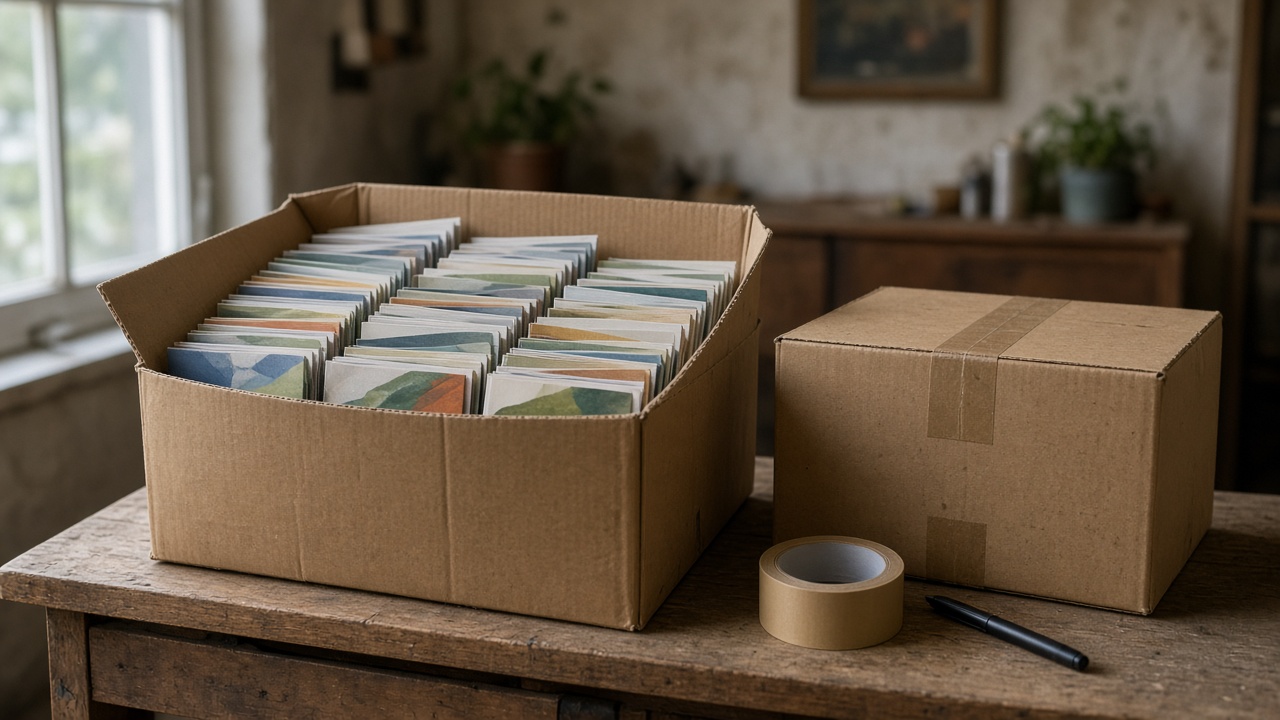
The box with last season’s prices
The printer quoted 250 catalogs and 1,000 catalogs side by side. The bigger order cost less per copy, so you took it. Then a supplier raised a price, a product was discontinued, or the phone number changed. Six hundred catalogs are still in the box, and every one of them is now wrong.
Print is not the problem. Printing more than you will hand out before the content changes is. This guide puts real 2026 numbers on a short catalog run and on mailing it, shows when paper still earns its money, and sorts the rest into what can go out as a link.
What does a short catalog run actually cost in 2026?
A 24-page, full-color, saddle-stitched letter-size catalog costs $2.59 a copy at 250 copies and $1.67 a copy at 1,000, in Short Run Printing’s catalog price table. The table was refreshed October 10, 2026, and includes ground delivery to New York. That is a 100 lb gloss cover and 70 lb gloss text inside.
| Order size | Total | Per copy, as quoted |
|---|---|---|
| 250 copies | $647.83 | $2.59 |
| 500 copies | $923.93 | $1.85 |
| 1,000 copies | $1,668.35 | $1.67 |
The quote is honest. The per-copy number is what misleads. It assumes every copy gets used. Going from 250 to 1,000 costs $1,020.52 more for 750 more catalogs. That money only buys something if those 750 reach a reader while the prices inside are still right.
When is the bigger print run a false saving?
The bigger order is a false saving when the content changes before you use the copies. Divide the 1,000-copy total by the copies you actually hand out, and the real cost per used copy appears.
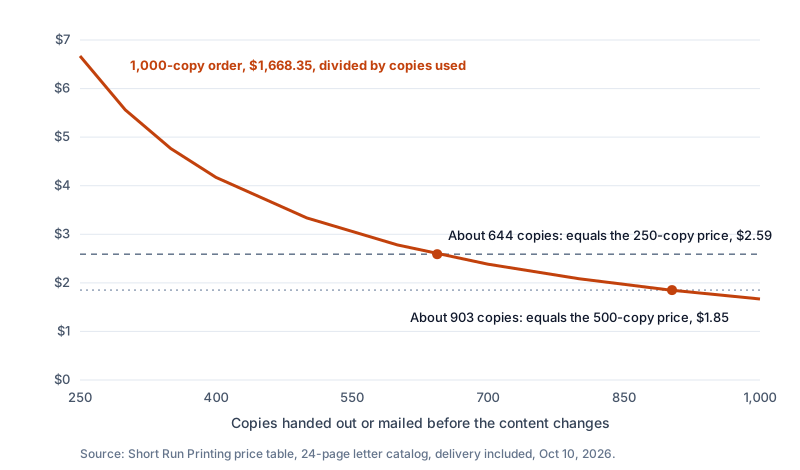
Using the same price table, $1,668.35 spread over 644 used copies is $2.59 each. That is exactly what the 250-copy order charged. So if fewer than about 644 of the 1,000 catalogs leave the box before you reprint, the “cheaper” order cost more for every catalog that did its job. Against the 500-copy order, the line sits at about 903 copies. Unless you are confident you will use more than nine in ten, 500 was the better buy.
That is the calculation to make before the printer’s quantity slider does it for you. Count how many you handed out last season, and how often the content changed. A price list that changes every quarter should be printed in the smallest run that covers one quarter, or not printed at all.
How much does mailing add to every printed copy?
Mailing adds $0.31 to $2.56 to each copy in 2026, depending on how the mail is prepared. The cheapest prices need a bulk mailing permit and presorted mail. Most small businesses hand that job to the printer’s mailing service.
| How it is mailed | Postage per piece, flats up to 4 oz | Source |
|---|---|---|
| USPS Marketing Mail, carrier route saturation, no entry discount | $0.308 | USPS 2026 Marketing Mail flats prices |
| USPS Marketing Mail, nonautomation, mixed | $1.299 | Same price file |
| First-Class Mail retail large envelope, 4 oz | $2.56 | USPS Notice 123, effective October 4, 2026 |
Does the 24-page catalog above stay under 4 oz? By our arithmetic, yes. Ten inside leaves of 70 lb text, at about 104 grams per square meter, and two cover leaves of 100 lb cover, at about 270, come to about 95 grams, or 3.4 oz, before an envelope. Weigh a printed sample before you trust that number. Heavier paper or more pages can push a catalog into the next price step.
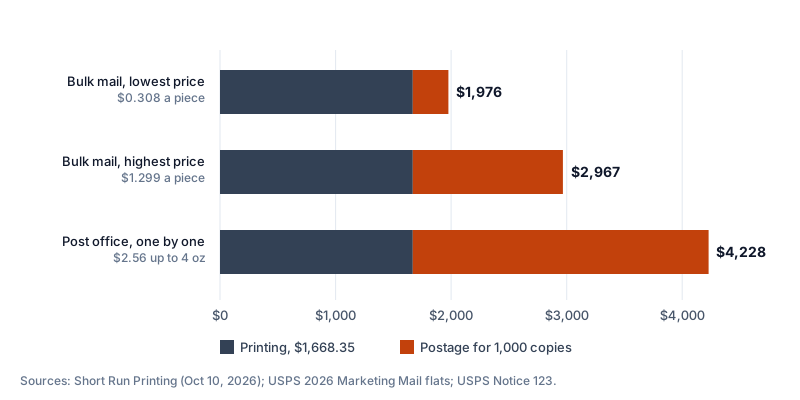
At 1,000 mailed copies, postage turns a $1,668 print job into $1,976 to $4,228. A catalog that goes out of date in the mail is the most expensive version of the problem, because you paid twice for every copy.
When does print still earn its money?
Print still earns its money when it goes to people who already buy from you. In the ANA Response Rate Report 2023, published February 22, 2024, direct mail sent to a house list, meaning a company’s own customers, returned 161%. That was the highest of every channel in the study. Email to house lists returned 44%. Direct mail to prospect lists returned 34%.
Treat those as directions, not promises. Each direct mail figure rests on 22 to 31 responding companies, and the report itself marks the prospect-list figures as a small base. Still, the pattern is useful. Paper sent to customers who know you does well. Paper sent to strangers on a bought list is much harder to justify.
The same report found that 82% of those who track direct mail response use online tracking such as QR codes or specific URLs. In other words, the companies that measure printed mail already connect it to something online. That is the middle path further down this guide.
- Mail to your own customers. The seasonal catalog to people who ordered last year.
- The counter and the event table. Someone picks it up, walks away with it, and has it in the kitchen drawer next week.
- Anything people write on. Order forms, price books a rep marks up, a workbook.
- What a customer, contract, or regulation requires on paper. If a printed notice is required, it stays printed.
What can go online instead?
Anything that changes often, runs long, or was going to be attached to an email anyway can go online. A link costs nothing per reader, and nobody receives last quarter’s prices after you fix them.
| Document | Keep in print | Send as a link | Why |
|---|---|---|---|
| Price list | Rarely | Yes | It changes. Every reprint is a new bill. |
| 60-page product catalog | A few for the showroom | Yes, for everyone else | A long run is expensive to print and to mail. |
| Brochure you email after a call | No | Yes | It was going to be an attachment. Large attachments bounce. |
| Seasonal catalog to past customers | Yes | Also, for those who prefer it | House-list mail is where print performs best. |
| Order form | Yes | Only if it is a web form | People write on it. A picture of a form cannot be filled in. |
| Onboarding pack, staff handbook | Rarely | Yes | It is read, revised, and read again. |
The business guide to online booklets and catalogs goes deeper on sales teams and catalogs. The short version: if a document is read, not filled in, and it will change, its paper copies have a shelf life.
How do you keep a short print run and a link working together?
Print the small run you know you will use, and put a QR code on the back that opens the full, current version online. The trick is where that QR code points.
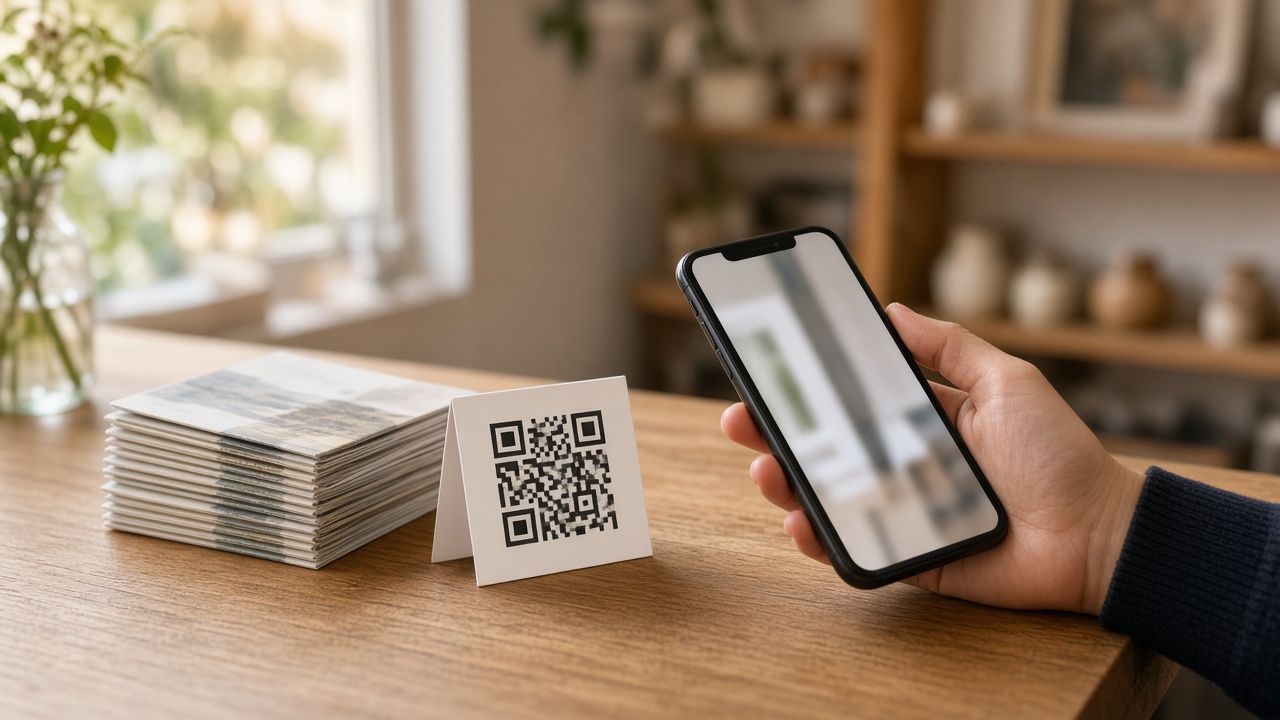
Point the QR code at a page on your own website, such as yourshop.com/catalog, not at the online book’s address. Put the online book on that page with an embed snippet. When the catalog changes, publish the new one and swap the embed on your page. The printed code never changes, because it points at your page, and your page always shows the current book. A QR code that points straight at one specific book’s link stays tied to that version.
- Print the smallest run that covers the counter, events, and the customers who want paper.
- Make a page on your site for the catalog. Keep its address short and permanent.
- Generate a QR code for that page address with any QR code generator, and print it on the back cover.
- Put the online catalog on that page. The embed guide has the steps for WordPress, Squarespace, Wix, and a hand-built site.
- When prices change, publish the new version and replace the embed. Reprint only when the paper copies run out.
How do you put the brochure online without a print bill?
Export the brochure as a PDF, then turn the PDF into something people can read in the browser. You already have the PDF if a printer ever received the file.
On pdftoflipbook.io, you drop the PDF and the preview is drawn in your browser. Turn two pages to check the order. Choose Share for a link you can text or email, or Embed for the snippet that goes on your catalog page. A guest can share a PDF up to 100 MB. An account reaches 300 MB. A press-ready PDF with crop marks and huge images may be heavier than that, so ask your designer for a screen version.
Two cautions. A shared link is public to anyone who has it, so leave internal cost notes and unreleased prices out of the file. The privacy guide covers what to check before you share. And if a folded leaflet or booklet is laid out for the printer, with pages imposed out of order for folding, export the reading order instead. The booklet guide explains the difference.
The short version
- Compare print quotes by total cost against the copies you will really use. The per-copy price assumes you use them all.
- Mailing adds $0.31 to $2.56 a copy in 2026. A catalog that goes stale in the mail costs you twice.
- Print earns its keep with your own customers, at the counter, and on forms. Price lists, long catalogs, and email attachments belong online.
- Put a QR code on the short run that points at your own page, and keep the current catalog on that page.
If the brochure is already a PDF, the online version is the part that costs nothing. Start with the email guide if the file you were going to send is too big to attach.